Academia establishes live electricity consumption monitoring system as part of DGvet-30 project
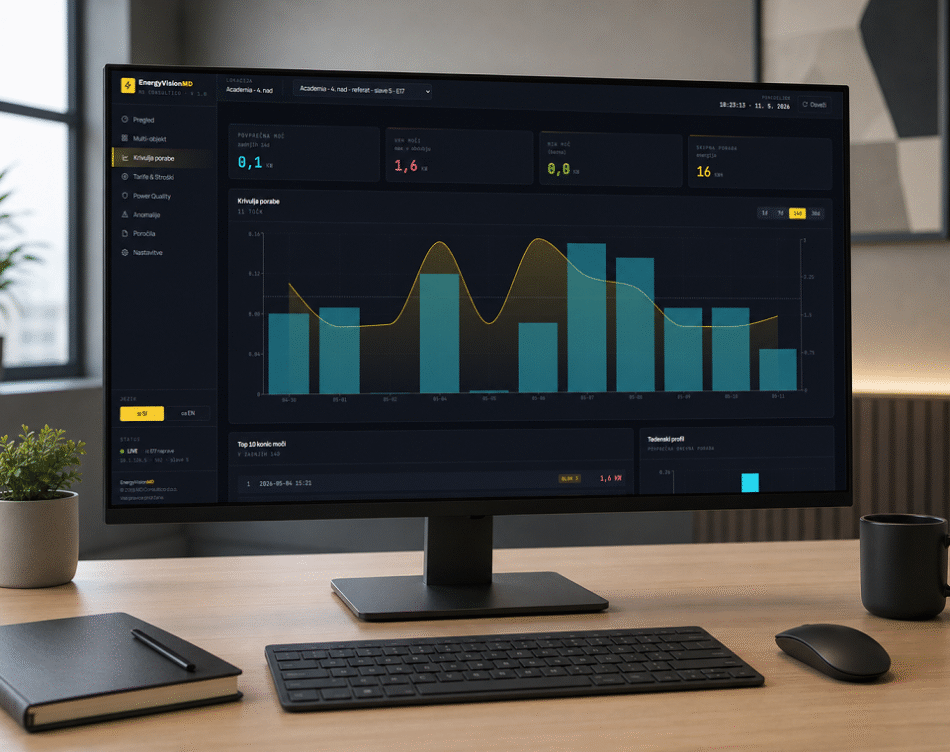
Academia has successfully set up and launched a real-time electricity consumption monitoring system as part of the European project Digital Green Consumption – 30 (DGVET-30). The system is already operating in a production environment and continuously records data from three measurement points on the infrastructure of the higher vocational school.
With this step, Academia is realizing one of the key goals of the DGVET-30 project - to connect digitalization with sustainable energy use and transfer the acquired knowledge into the educational process and professional training of students.
WHAT WE SET UP
The metering infrastructure is based on Socomec COUNTIS industrial meters (models E27 and E17), which are MID certified (Measuring Instruments Directive, EU 2014/32) and are suitable for sub-account billing. The meters monitor the full range of parameters: voltage, current, active and reactive power, power factor, frequency, harmonic distortion and energy meters according to tariffs. The accuracy class for active energy is 0.5S.
Communication between the meters and the collection unit is carried out using the Modbus TCP protocol over the local network. A dedicated server (Linux, CentOS Stream 10) reads measurements every 60 seconds, validates them and stores them in a database with a two-year history, and the data is accessed by a REST API interface with advanced endpoints for history, consumption aggregation, cost calculation, power quality analysis according to the EN 50160 standard and anomaly detection.
ENERGYVISIONMD ONLINE PLATFORM
All measurements are available through our proprietary web portal EnergyVisionMD , which is accessible from any browser. The platform includes:
real-time dashboard with automatic refresh,
review of load curves and daily consumption profiles,
tariff distribution and cost breakdown,
Peak Shaver module for predicting and warning about power peaks,
electrical power quality inspection in accordance with EN 50160,
automatic anomaly detection with classification by severity,
generation of professional reports in PDF, XLSX and CSV format.
The interface is available in Slovenian and English.
WHAT THIS MEANS FOR ENERGY EFFICIENCY
Monitoring your consumption live is the first and necessary step towards real savings. Without data, we don't know where energy is going, when peaks occur, and how much it costs us. The system set up by Academia allows:
Instant detection of inefficiencies. Consumption anomalies – appliances left on outside of business hours, faulty heaters, excessive reactive energy – are visible in hours instead of only on the monthly bill.
Managing peak power consumption. The Peak Shaver module predicts high loads and warns responsible persons in time, which means direct savings on the power consumption item on the electricity bill.
Better power quality. Monitoring compliance with EN 50160 (voltage deviations, harmonic distortion, dips) protects equipment and reduces maintenance costs.
Basis for decisions. A two-year data history enables comparisons between years, evaluation of the effects of investments in energy renovation, and setting realistic goals for reducing consumption.
Educational value. The system is a living learning tool – students monitor real data, learn to read meters, analyze consumption profiles, and understand how energy efficiency is expressed in numbers.
CONTRIBUTION TO EU OBJECTIVES
The DGVET-30 project fits into the broader framework of European climate goals: reducing CO₂ emissions by 55% and reducing energy consumption by 11.7% by 2030. The system established at Academia is a concrete example of how these goals are translated into the everyday practice of an educational institution - with measurable, verifiable data and with knowledge that students take with them into the economy.
In the coming months, we will use the collected data to prepare didactic units that will also be available to other partner institutions of the DGVET-30 project.

The DigitalGreenConsumption-30 project (No. 2024-ES01-KA220-VET-000257043) is co-funded by the European Union under the Erasmus+ KA220-VET programme. The content of this article reflects the views only of the author, and the European Commission cannot be held responsible for any use which may be made of the information.